The Community would need to fund its investment and is likely to need to raise third party financing to fund the full Investment Price if it does not have access to sufficient cash. Third party funding will have an interest cost (if it is a debt funding) and also require the capital amount to be repaid. The interest and capital repayment are known as Debt Service. Any cash remaining once Debt Service has been paid would be available to the community to distribute as profit.
The third-party funding could come from different sources, including crowd funding from the Community, third party investors or banks.
The scenario illustrated below assumes some funding is raised from the Community itself through individuals buying shares (or similar) in the Community company which would make the investment. It assumes the Community funding receives a fixed (or capped) percentage return plus equity capital repaid at the end of the Project.
The remaining funding is assumed to be sourced from a bank loan. The bank must be paid interest and capital over the tenor of the loan, normally on a fixed repayment profile agreed when the loan is taken out.
Four examples below show how changing the proportion of the Community funded equity portion and the bank loan impact the ability for the Community to meet its funding costs and have sufficient excess cash, or profit, to be utilised as it sees fit.
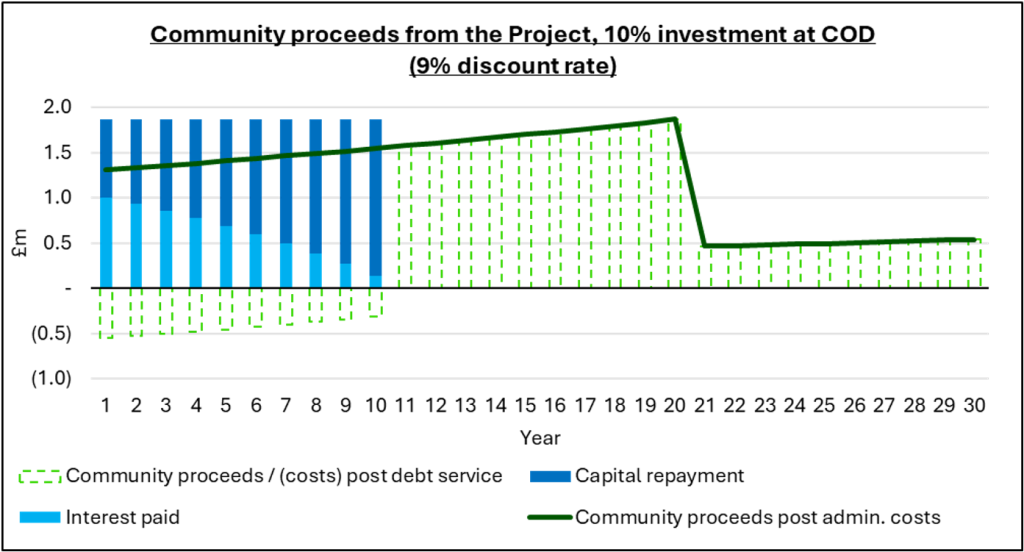
Example 1 – £2m Community funding, 10y debt terms
The green line in the graph below shows the Community’s returns from the Project before paying funding costs. In this example, there is insufficient cash available to meet all Debt Service costs. The dotted green bars below zero show the shortfall in income which is needed to service the Community’s funding costs.
This is a cash flow timing problem which would need to be overcome. Once the debt is repaid there is positive free cash available to pay the Community equity funding return and profit for the Community.
To solve the early cash shortfall problem, the Community would need to do one of, or a combination of:
- Increase the amount of equity it can raise, this would reduce the size of the loan it would need to repay. Equity investors would still expect a return but may be paid over a longer period than that required by a bank.
- Get a loan which has a lower cost of interest and/or is repaid capital over a longer period.
- Negotiate a lower upfront investment price for the same proportion of ownership in the project (a higher Discount Rate, and therefore higher return).
This illustrates potential approaches that may be considered in practice; however, each involves further risks, trade-offs and would require independent advice.
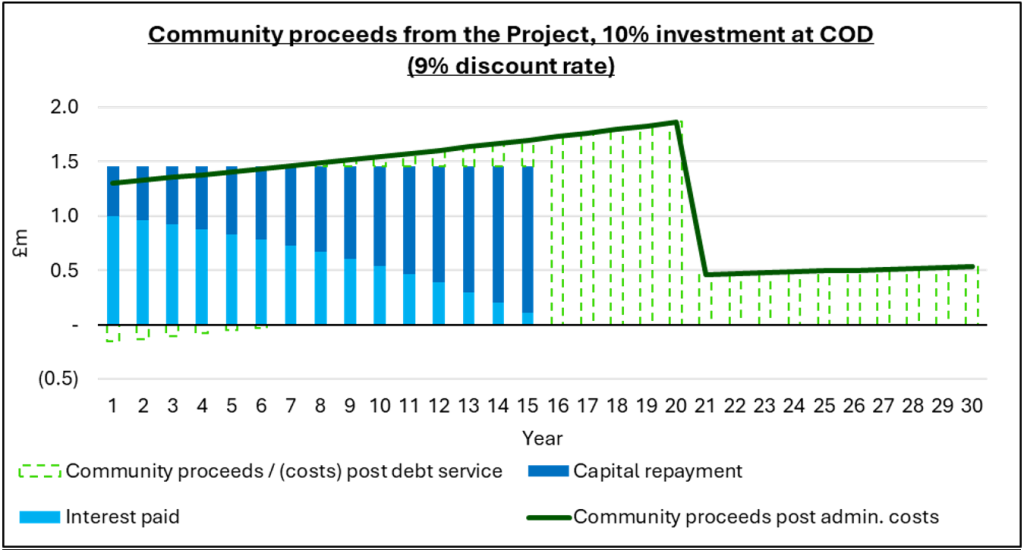
Example 2 – £2m Community funding, 15y debt terms
The example below assumes that the Community is able to raise debt which is repaid over 15 years rather than 10 years. The cash shortfall is significantly lower than in the 10 years terms modelling presented in the previous example. While there is still a small shortfall in the initial years, this could likely be managed through slight adjustments to debt repayment profile or decreasing the loan slightly (for example, the Community could increase its equity participation to reduce debt raised).
Example 3 – £5m Community funding, 10y debt terms
The example below shows the impact of a higher share of funding provided by the Community itself. This reduces the amount of funding required via a loan and therefore reduces the associated interest and capital repayment requirements. The cash shortfall is therefore lower than in the £2m Community funding modelling presented above.
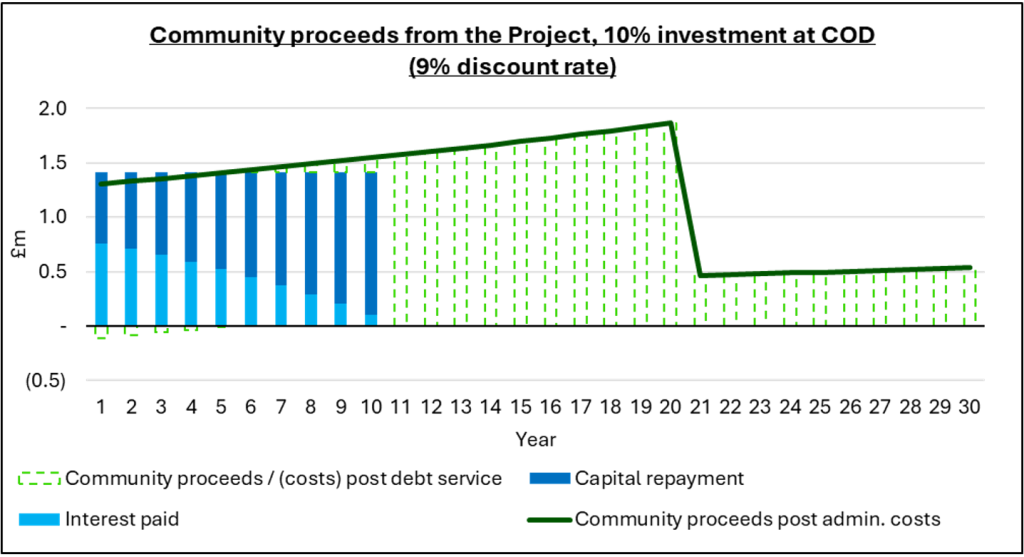
It is worth highlighting that traditional lenders will typically require some headroom between the amount of cashflow expected from a Project over the amount of cash needed to meet interest and capital repayments. This headroom provides them with a buffer in the event that the project does not perform as expected. While the two previous examples (Examples 2 and 3) broadly have sufficient cash to meet the third party finance costs, the lender may be unwilling to lend that amount of debt to the Project based on the forecast given there is no material headroom between the proceeds paid to the Community and the Debt Service.
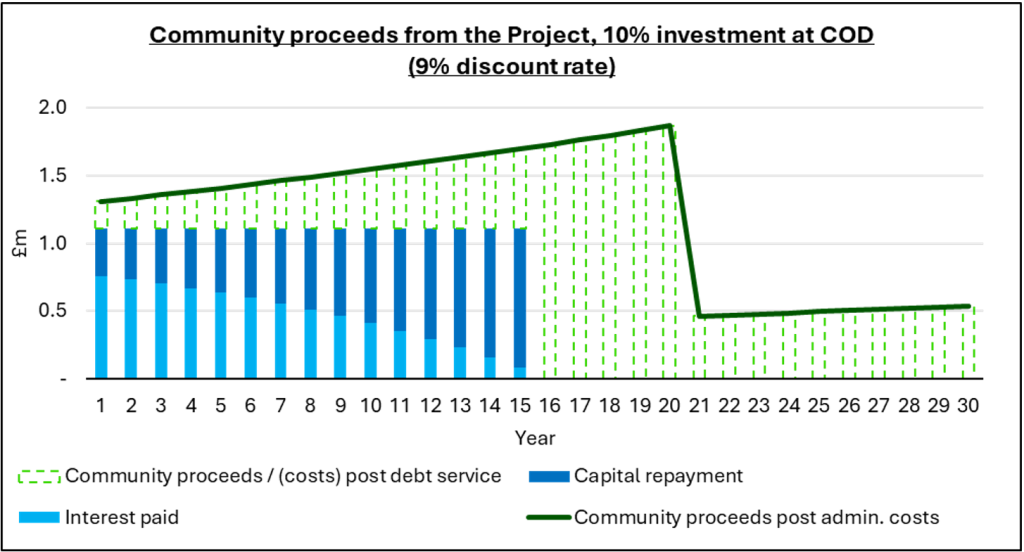
Example 4 – £5m Community funding, 15y debt terms
This example shows the combined impact of a higher share of funding raised from the Community, plus a longer debt term. With the set of assumptions used, it generates a positive Net Profit for the Community from the first year of operation and provides headroom of cash paid from the Project to the Community over and above the third-party Debt Service.