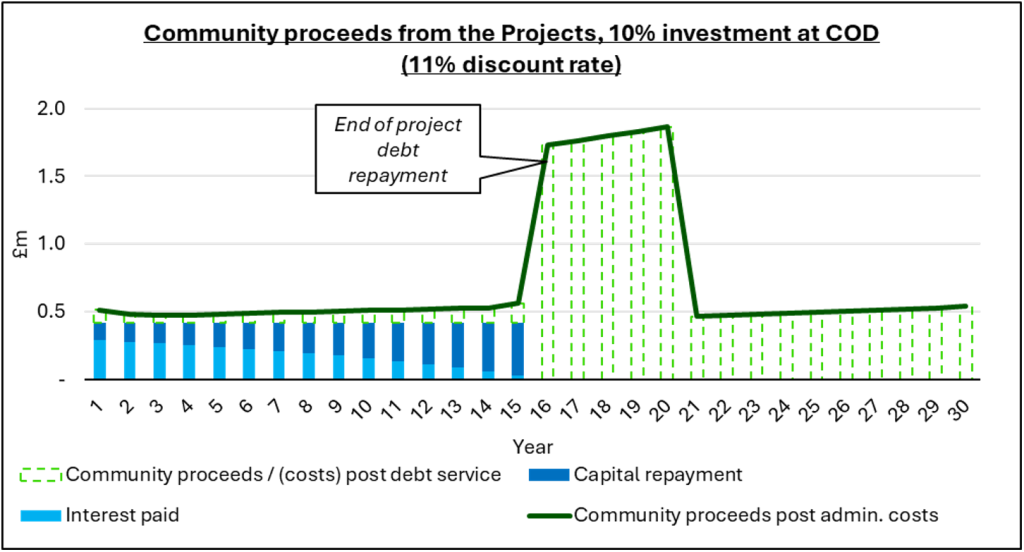
The developer of the Project may use debt financing to fund the underlying Project. This would usually rank senior to any profits payable to equity, meaning the debt interest and capital due in each period must be repaid before any cash is distributed to shareholders (before the Community is paid any return on its investment).
The Community Investment Price required to acquire a proportion of the Project would be lower than if there was no debt at the Project level. This is because the cashflow available after Debt Service is lower, so the Fair Value will be lower (the At Cost investment price will also be lower as the developer will only fund the difference between Project cost and debt raised). Additionally, the cash flows associated with the investment would be comparatively riskier, as any returns are only paid after the debt has been serviced. If the Project underperforms, lenders will be paid in priority, before shareholders. It is therefore likely to attract a higher Discount Rate than an equity investment with no underlying Project debt. As demonstrated above, a higher Discount Rate will result in a lower upfront Investment Price.
| In £m | Total Project cost | Debt raised1 | Initial invest. from Project’s shareholders | Fair Value Discount Rate used2 | Community investment at COD | Community proceeds |
| No project debt | 135.8 | – | 135.8 | 9% | 14.5 | 36.4 |
| Project funded with debt | 135.8 | 95 | 40.7 | 11% | 5.6 | 21.6 |
- Debt raised at Project level by the developer.
- A higher Discount Rate has been used as an example to reflect the riskier Project proceeds during the Project debt repayment period. It should not be relied upon as an appropriate Discount Rate or proportional adjustment to apply to the Discount Rate.
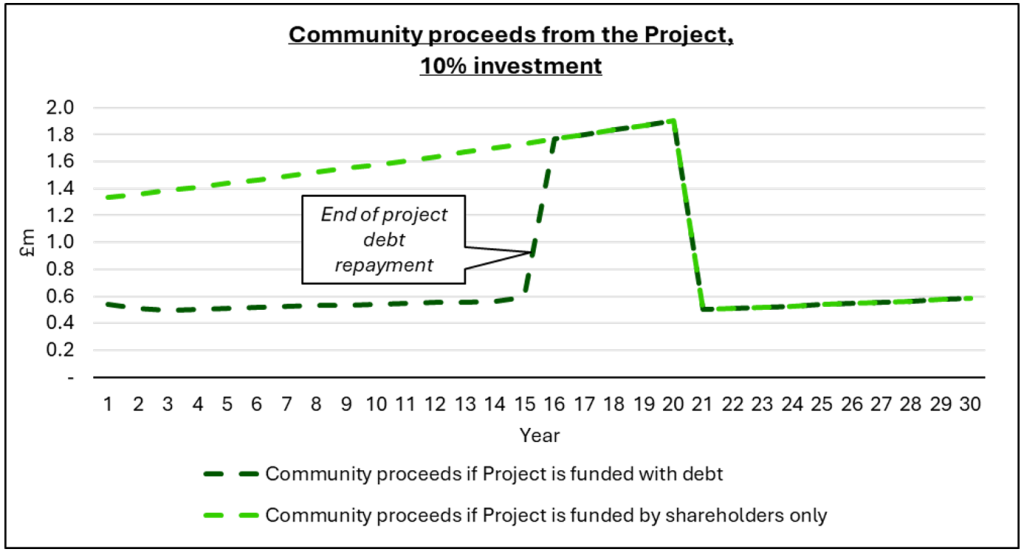
The profile of the Community’s proceeds will also change if there is underlying Project level debt. As can be seen below, the proceeds are materially lower while the Project is repaying the Project debt and interest, when compared to the Community proceeds if the Project is not funded using debt. Once that is paid off, the amount distributed to the Community steps up. The illustration assumes the same electricity price as with the earlier example.
Example – £2m Community funding, 15y debt terms – after project level debt
The illustration below shows what the return profile may look like using the Community funding assumptions of £2m equity funding and the remainder provided by a third-party loan. Compared to above illustrations without Project level debt, the Investment Price is reduced as well as the loan amount the Community needs to raise. Once the Project level debt is repaid, the profile of proceeds for the Community steps up.