

When a Community is offered a shared ownership investment stake, the amount that it is asked to invest (Investment Price) is usually based on one of the following methods:
- ‘At Cost’: The Investment Price is based on the actual capital expenditure incurred to build the Project. Essentially paying the developer for a proportion of the costs incurred in the development, construction, turbines and grid connection at face value, with no premium layered on top.
- ‘Fair Value’ or ‘Market Value’: Reflects what a third-party buyer would rationally pay for the equivalent investment. It is usually the cost plus a premium to reflect that the Project has been derisked by the developer (for example planning, permits, grid and potentially route to market may have been secured). This is usually calculated by forecasting the future cashflows for the Project, including any costs related to the investment, and then discounting those cashflows back to today’s terms using a Discount Rate. This is known as the Net Present Value (‘NPV’) of the forecast future cash flows. The Discount Rate should reflect the required rate of return of an investor would seek to invest in such project.
Both the forecast future cash flows and the choice of Discount Rate materially influence the value and therefore the Investment Price (see explanations below on how these could change the investment quantum). In general, the Community should expect a Fair Value offer to require a higher investment for the same proportion of ownership than the investment required for an equivalent At Cost offer.
- ‘Discount to Market Value’: As it states, this is an Investment Price offered at a discount on a basis set out by the developer offering the investment. The value would normally sit between the Fair/Market Value or At Cost examples set out below.
Fair Value explanation
The Fair Value Investment Price will be higher if the forecast cashflows for the Project are higher, and vice versa, at the point the Investment Price is calculated. The forecast cashflow is a projection of the revenues and costs associated with the Project and are typically calculated in a spreadsheet using Project level (for example, project costs and energy generation) and macro-economic (for example. power prices, inflation, interest rates etc) assumptions. The resulting cashflow is highly sensitive to changes in those assumptions. The assumptions that underpin the cashflow are therefore very important and should be reviewed and diligence conducted as part an investment offer process. The Community should also acknowledge that the forecast cashflow is highly unlikely to reflect actual outturn.
The choice of Discount Rate for a Fair Value investment is the other key variable in determining what the Investment Price is. The lower the Discount Rate, the higher the valuation and therefore Investment Price (the Discount Rate is related to the risk of an investment, a lower Discount Rate reflects a lower perceived risk thus a higher initial valuation for the same future cashflows). Changing the Discount Rate, with all other assumptions remaining the same, will only change the Investment Price. The actual future cash flows which a Community would receive for its Fair Value Investment do not change compared to an At Cost investment in the same Project.
| Fair Value Discount Rate | Valuation | Funding outcome |
| Low Discount Rate | Higher valuation | Higher investment price |
| High Discount Rate | Lower valuation | Lower investment price |
Stage of development: FID vs COD
Shared ownership opportunities can be offered to Communities with the ability to invest either at Final Investment Decision (‘FID’), the point when the developer commits to construction, or once Commercial Operations Date (‘COD’) has been achieved (in other words, construction is complete). The latter is the most common case. If investment is made at FID, depending on discussions with the project developer, the Community could either invest the full investment price at FID date or throughout construction as the costs are incurred by the Project. If investment is made at COD, the Investment Price is likely to be paid in one go.
Investing at FID means the Community may be taking on construction risk, which includes the possibility of cost overruns, delays, turbine supply issues or grid connection complications. In practice, this means the Investment Price may change, if cost overruns occur, and the time for the Project to generate a profit may be delayed (or in a worst case does not happen).
The At Cost value will be the same whether the Community invests at FID or COD, although the total amount may not be known at FID if costs are higher or lower than expected during construction.
An FID Fair Value would typically attract a higher Discount Rate and therefore lower Investment Price (which may translate into a higher expected return) in exchange for bearing that construction risk. The Community may also participate in any upside if the Project is delivered under budget or ahead of schedule.
Investing at COD means the construction risk has already been retired, the wind farm is generating power and the revenue profile is known with greater certainty (price per MWh may be secured with a CfD or long-term contract, although there is still risk that the Project generation does not perform as forecast with lower wind than forecasted or lower turbine availability). The Fair Value Investment Price will reflect this de-risking, with a lower Discount Rate applied meaning the Investment Price is higher and the resulting return is lower.
An additional technical impact of the NPV calculation (if Investment Price is calculated at Fair Value) is that an FID investment happens earlier than a COD investment so the future cashflows would be discounted more, resulting in a lower Investment Price. The comparison on timing and value assume nothing else changes (meaning all other underlying assumptions are the same). This may not be the case, as Project and macroeconomic variables will change with time and may move positively or negatively between FID and COD.
| Entry point | Risk | Discount rate/return | Valuation/investment price |
| Invest at FID | Higher risk (Construction and ops) | Higher | Lower valuation |
| Invest at COD | Lower risk (ops only) | Lower | Higher valuation |
Illustrative values
The table below illustrates the potential Investment Price required for the respective stakes in a 75 MW wind farm on different valuation bases and at different points in time. It assumes the underlying Project is wholly equity funded (meaning that the project’s developer does not raise any debt or other third party financing at project level).
The table shows two Discount Rates for Fair Value (denoted ‘FV’) which are purely presentational to illustrate how a comparatively lower or higher Discount Rate impacts the Fair Value calculation. They do not represent what a market Discount Rate for Fair Value should be. In these scenarios, the investment return would be equal to the Discount Rate, assuming the cashflows (and therefore underlying assumptions) used in the valuation transpire as forecast.
| Indicative community Investment Price | 5% ownership | 10% ownership | 20% ownership |
| A. At Cost | £6.8m | £13.6m | £27.2m |
| B. FV at 7% – FID | £7.5m | £15.1m | £30.2m |
| C. FV at 9% – FID | £6.1m | £12.2m | £24.4m |
| D. FV at 7% – COD | £8.6m | £17.3m | £34.5m |
| E. FV at 9% – COD | £7.3m | £14.5m | £29.0m |
A few reflections can be drawn from the values above:
- The relationship between ownership percentage and required Investment Price is, at a high level, linear. For example, if a Community had the option to invest to acquire 5% or 10%, the Investment Price would be approximately double for a 10% stake versus a 5% stake. The associated percentage return would remain the same, although the cash receipts would be greater (it would double) as the Community would earn the same percentage return on a larger investment.
- The Investment Price is higher, all else being equal, if a Community invests at COD rather than FID using the same discount rate. For example, in the table the values for row D are higher than the values for row B. This is due to the ‘time’ element of the NPV calculation, where the future cashflows are closer to the time of investment (they are discounted less) when investing at COD compared to investing earlier at FID. Investing at FID, or during construction, means the Community gets no return during the construction period so has to wait longer to start to make a return on the investment.
- As outlined before, the higher the Discount Rate the lower the Fair Value amount (see C vs B and E vs D). A Fair Value (or Market Value) would normally attribute a lower Discount Rate to an investment at COD than at FID, to reflect the fact the there is less risk remaining within the Project and associated investment.
The payments (or profit) which the Community may receive for its investment are not flat throughout the Project life. The illustration assumes the wind farm will benefit from a 20-year Contract for Difference (‘CfD’) contract and thereafter will sell any electricity it generates at the prevailing electricity market price. The illustration assumes the market price will be significantly lower than the CfD price (such market price will not be known until the time and may be materially different to the assumption used), and therefore the profit generated during the CfD period is forecast to be higher than after the CfD contract ends. The graph below illustrates what this would look like assuming a 10% ownership stake. The proceeds shown are before the Community incurs any costs associated with funding its investment.
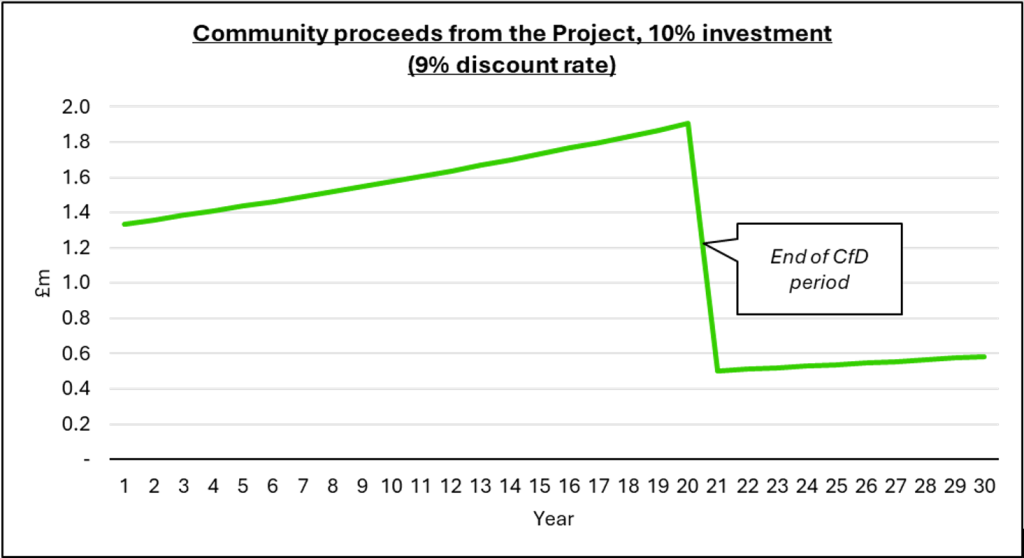
The actual revenues and profit distribution is unlikely to be as smooth as illustrated in the chart, there may be good years where profit is higher and bad years where profit is lower (subject to wind generation, turbine availability, changes in operating costs, changes in taxes, changes in revenues etc.)
The CfD price is index linked and backed by the UK government so is relatively reliable as a sale price for electricity. The forecast electricity price from 2049 is much more uncertain and could imply materially higher or lower Community proceeds than that portrayed.
